If your Shopify store is based in Italy, how you charge VAT depends on whether your business is VAT registered.
Italy applies a standard VAT rate to domestic sales. Once you start selling to customers in other EU countries, the VAT you charge depends on your turnover and whether you're selling to businesses or consumers.
Once your tax settings are configured correctly, Sufio—a trusted invoicing app for Shopify stores—automatically generates invoices with the correct VAT breakdown for every order.
This guide walks you through how to configure tax settings and tax rates in Shopify so you charge the correct VAT to every customer, whether they're based in Italy, elsewhere in the EU, or outside the EU.
Last updated on July 27, 2026.
Caution
On January 1, 2025, new EU VAT regulations came into force. Among other changes, the EU introduced a new simplified VAT scheme for small and medium-sized enterprises (SMEs).
Under this new scheme, businesses with an annual turnover below €100,000 across the EU may now qualify to be VAT-exempt.
Each EU country is implementing these rules separately, so check with your local tax authority.
In this article, we will discuss
To charge VAT to some customers and not to others, Shopify offers two ways to configure VAT, based on how you want to display product prices in your online store.


Expand with confidence. Sufio invoices are compliant in over 50 countries and available in 40+ languages.
Start a free trialFor B2C sales, displaying prices with VAT included shows shoppers the exact amount they'll pay at checkout.
To display your product prices with VAT included while still allowing business customers to have VAT deducted at checkout:
- In your Shopify admin, go to the Settings → Taxes and duties page.
- In the Global settings section, check Include sales tax in product price and shipping rate.
- Click Save to apply the changes.
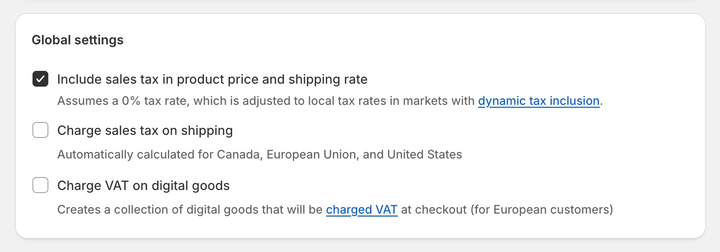
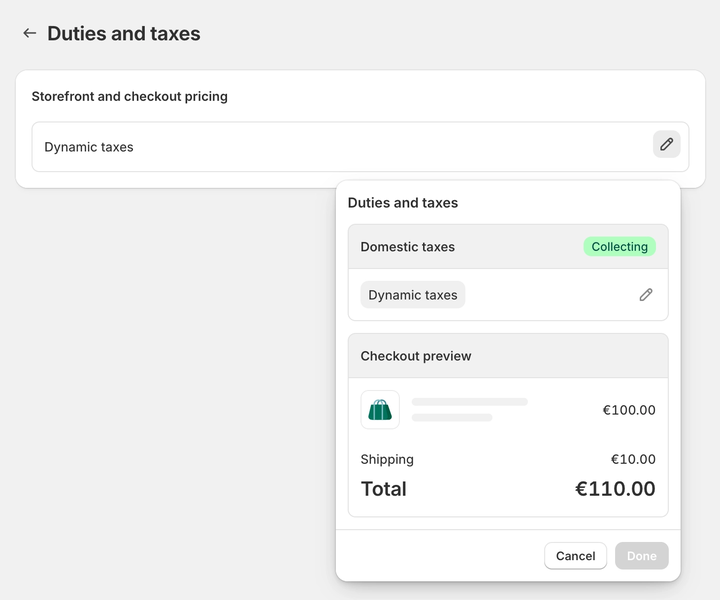
Optionally, you can enable dynamic tax inclusion.
This Shopify feature automatically includes or excludes the tax based on the customer's region and adjusts the tax rate accordingly.
To activate dynamic tax inclusion:
- In your Shopify admin, go to Settings → Markets and select the market you want to configure for tax collection.
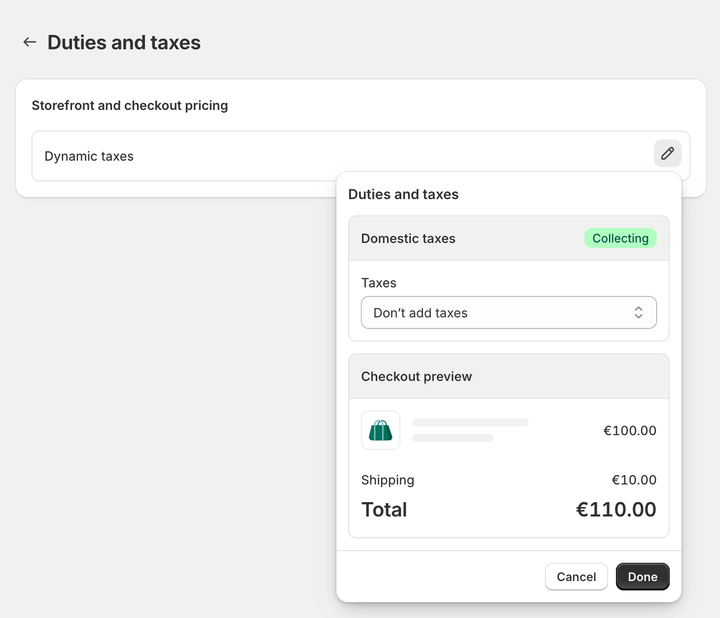
- Click Duties and taxes, then click Edit next to Storefront and checkout pricing.
- Under Domestic taxes, select Dynamic taxes, then click Done.
- Click Save to apply the changes.
If most of your customers are businesses (B2B), displaying prices excluding VAT is the more common approach, since B2B buyers typically expect to see net prices before tax.
To display your product prices excluding VAT:
- In your Shopify admin, go to the Settings → Taxes and duties page.
- In the Global settings section, uncheck Include sales tax in product price and shipping rate.
- Click Save to apply the changes.
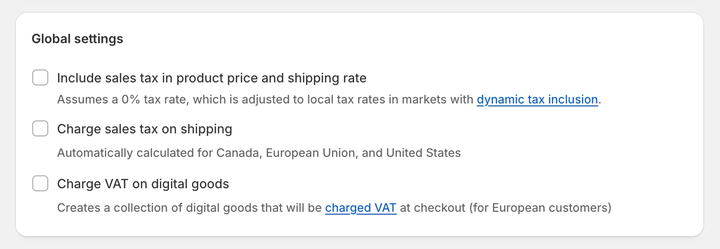
You can also disable dynamic tax inclusion if you'd rather keep prices consistently VAT-excluded across all markets:
- In your Shopify admin, go to Settings → Markets and select the market you want to configure for tax collection.
- Click Duties and taxes, then click Edit next to Storefront and checkout pricing.
- Under Domestic taxes, select Don't add taxes, then click Done.
- Click Save to apply the changes.
As of 2026, the standard VAT rate (IVA, or Imposta sul valore aggiunto) is 22%.
Reduced rates of 10%, 5%, and 4% still apply to specific categories, such as foodstuffs and beverages, books and newspapers, and medicines.
If your business is VAT registered, you generally charge Italian VAT on domestic sales to both businesses and consumers.
Businesses operating under Italy's regime forfettario generally don't charge VAT.
The regime is available only while the applicable turnover conditions are met, including the €85,000 annual threshold. Businesses can also choose to register for VAT voluntarily or may be required to do so depending on their circumstances.
If your business is in Italy and you are VAT registered, you must charge VAT to some customers and not others. It all depends on where your customers are located.
When selling goods B2B to other EU Member States, these sales are zero-rated: you still show VAT on your invoices, but at 0%. Under the reverse-charge mechanism, the customer accounts for the VAT themselves.
When selling goods B2C to other EU Member States, you do charge VAT, but the rate depends on whether your sales breach the micro-business threshold.
If your taxable turnover outside Italy, but within the EU, stays below €10,000 (excluding VAT) in a calendar year, you qualify for the micro-business exemption.
Under this scheme, you charge your home country's VAT rate, using a single VAT registration for all EU sales.
To use this scheme, apply for the exemption with your local tax authority. Once approved, set up your tax settings in Shopify admin—this only needs to be done once.
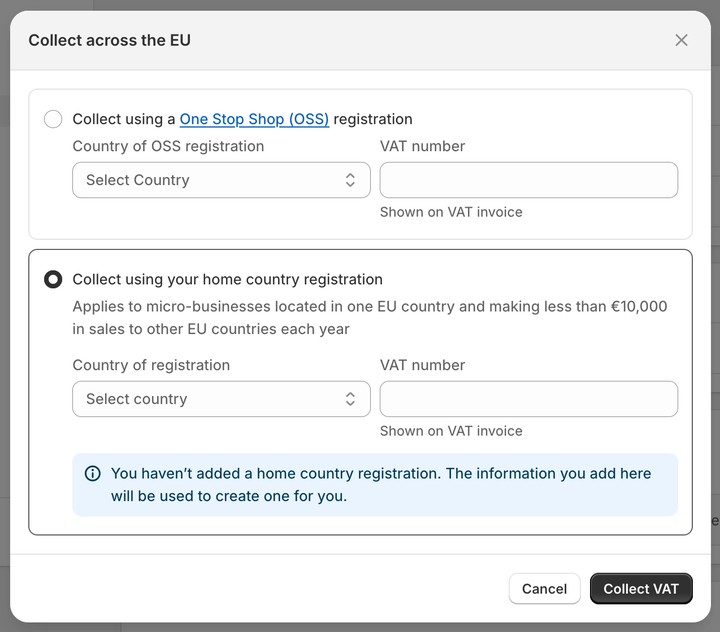
To set VAT rates for the micro-business exemption scheme and charge your home country's VAT rate on all orders:
- In your Shopify admin, go to the Settings → Taxes and duties page.
- In the Regional settings section, click European Union.
- In the Collect VAT cross-border section, click Collect VAT.
- In the Collect across the EU window, select Collect using your home country registration.
- Select your Country of registration and enter your VAT number. Leave this field blank if you've applied for a VAT number but don't have one yet; you can add it later.
- Click Collect VAT to save your changes.
Once your combined sales to other EU Member States in a calendar year exceed €10,000 (excluding VAT), you must charge the VAT rate of the country you're shipping to.
In practice, this means customers in different EU countries will be charged different VAT rates, ranging from 17% to 27%.
Registering for VAT separately in each EU country you sell to is time-consuming.
The One Stop Shop (OSS) Union scheme addresses this issue. You still charge VAT at the rate of the customer's country, but you only need to file a single OSS VAT return covering all your EU sales.
Shopify lets you set up these tax settings for individual VAT registrations and automatically charges the correct tax to your EU customers.
To set VAT rates for the OSS scheme and charge your customers' shipping-country VAT rate on all orders:
- In your Shopify admin, go to the Settings → Taxes and duties page.
- In the Regional settings section, click European Union.
- In the Collect VAT cross-border section, click Collect VAT.
- In the Collect across the EU window, select Collect using a One Stop Shop (OSS) registration.
- Select your Country of OSS registration and enter your VAT number. Leave this field blank if you've applied for a VAT number but don't have one yet; you can add it later.
- Click Collect VAT to save your changes.

From now on, your customers' shipping-country VAT rate will apply automatically to all EU sales.
If your taxable turnover in a different EU country exceeds its local VAT threshold, you'll need to register for a local VAT number there and charge that country's VAT rate.
For example, if your business is based in Italy but you've registered for VAT in Germany, the Italian rate of 22% still applies to your sales in every other EU country, while your German customers are charged the German rate of 19%.
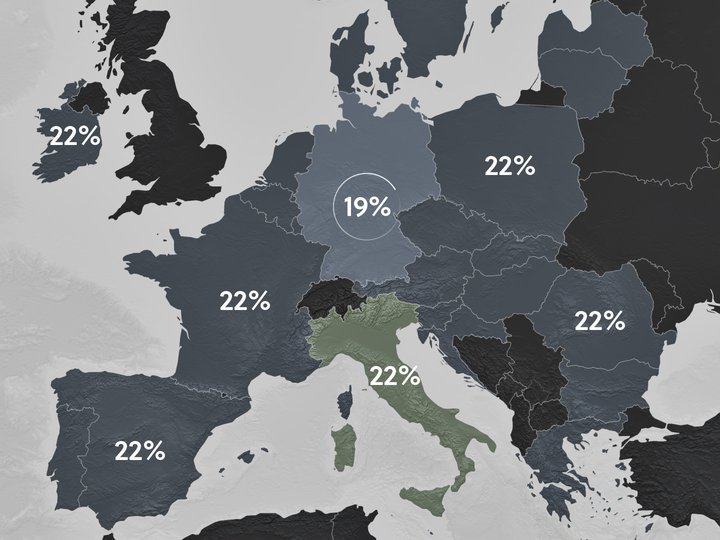
To charge your German customers the correct VAT rate, add the German VAT registration number to your tax settings.
In Shopify, you can add a local VAT registration number for any additional country, and the correct rate will be applied automatically based on that registration.
To add a local VAT registration number:
- In your Shopify admin, go to the Settings → Taxes and duties page.
- In the Regional settings section, click European Union.
- In the Collect VAT in an EU country section, click Collect in another location.
- Select the Registration country and enter your VAT number. Leave this field blank if you've applied for a VAT number but don't have one yet. You can add it later.
- Click Collect VAT to save your changes.
- To add registration numbers for additional countries, repeat by clicking Collect VAT in an EU country and confirming with Collect VAT.
If you can't select an additional country you're VAT-registered in, you may need to create a shipping zone first:
- In your Shopify admin, go to the Settings → Shipping and delivery page.
- In the Shipping section, click the shipping profile you want to add zones to.
- In the Shipping zones section, click Add shipping zone.
- Name the zone, add the country (or countries) you're VAT-registered in using the search bar, and click Done.
- Add shipping rates to make the zone available.
- Click Save to apply the changes.
When selling digital goods (such as e-books, downloadable music, stock photographs, or online courses) to customers in the European Union, you should charge VAT at the rate applicable in the customer’s country.
If you're selling goods from Italy outside the EU, whether B2B or B2C, these sales are exempt from VAT. This means you don't charge VAT on your invoices.
For personalized advice based on your specific business situation, consider consulting a tax professional or accountant who specializes in VAT and ecommerce.
Once your tax rates are set up correctly, Sufio automatically generates and sends invoices, credit notes, and other required documents with a clear VAT breakdown.
Invoices can be created in different languages and include all the necessary details to make them compliant with invoicing legislation in the EU.
Issuing invoices with the correct tax breakdown is crucial for your bookkeeping and tax purposes.
Sufio invoices display all required information, including the VAT registration numbers (P.IVA, or Partita Imposta sul Valore Aggiunto) of both your store and your business customers, as well as your customers' Codice Fiscale (C.F.).