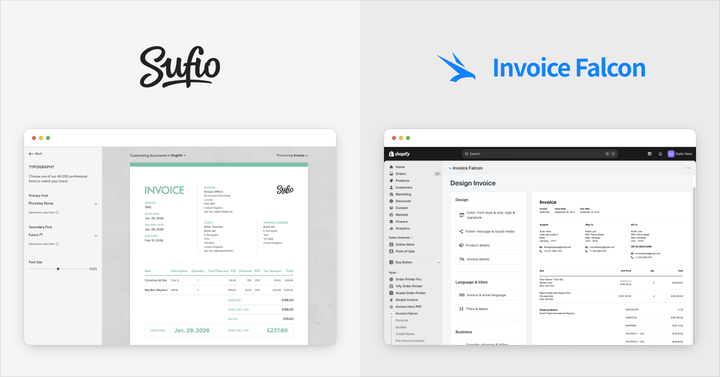
Both Sufio and Invoice Falcon help Shopify merchants generate invoices and other necessary documents, but they take two very different approaches.
Invoice Falcon is an order printer app. Its main purpose is to generate documents directly from the latest order data in Shopify, typically only when requested.
Sufio, by contrast, is a professional invoicing app that’s fully integrated with Shopify. It stores invoices as independent financial documents and automates the full invoicing workflow, including follow-up documents like credit notes.
What is the difference between order printers and invoicing apps?
While both types of apps assist Shopify merchants in creating invoices, they take distinct approaches to data integrity, document updates, and compliance.
Order printer apps
Order printer apps generate invoices from the latest order data in your Shopify store. At first glance, this seems convenient, but it can quickly become a drawback because orders frequently change.
Customers may request partial refunds, or you might edit an order to add or remove items.
When this happens, the app regenerates the invoice to reflect the updated order. As a result, multiple versions of the same invoice can exist, meaning you and your customers may no longer be looking at the same document.
In many countries, invoices are expected to remain unchanged once they have been issued to customers, accountants, or tax authorities.
Having several versions of the same invoice can therefore create both legal and accounting risks and may result in problems with your local tax authority.
The upside of order printer apps is cost. Because these apps rely entirely on Shopify’s order data and do not store separate invoice records, they are usually very affordable.
Invoicing apps
Invoicing apps like Sufio take a different approach by keeping invoices separate from the underlying order data in your Shopify store. This ensures that once an invoice is issued, it remains unchanged and retains its value as a valid financial document.
If an order is later modified, such as through a refund or item adjustment, the original invoice is left untouched. Instead, the app generates additional documents to capture the change.
For example, a credit note records refunded items, creating a clear and auditable trail without altering the original invoice.
Compared to order printer apps, invoicing solutions typically include features designed to meet legal requirements, such as sequential invoice numbering or support for e‑invoicing standards. This makes them a better fit for businesses that need to stay compliant.
These benefits come at a higher cost, reflecting the more robust systems involved.
Since invoicing apps store independent copies of financial documents, choosing a reliable and secure provider becomes increasingly important as your invoicing volume grows.
Feature comparison
Here's how Sufio and Invoice Falcon compare across the features that matter most to Shopify merchants.
Invoice automation
Sufio is built around a fully automated workflow. It creates and sends invoices based on specific triggers, such as when an order is paid or fulfilled. You can customize exactly when documents are generated and which types of orders they apply to.
It also automatically issues credit notes for returns and refunds, and sends reminders for overdue invoices.
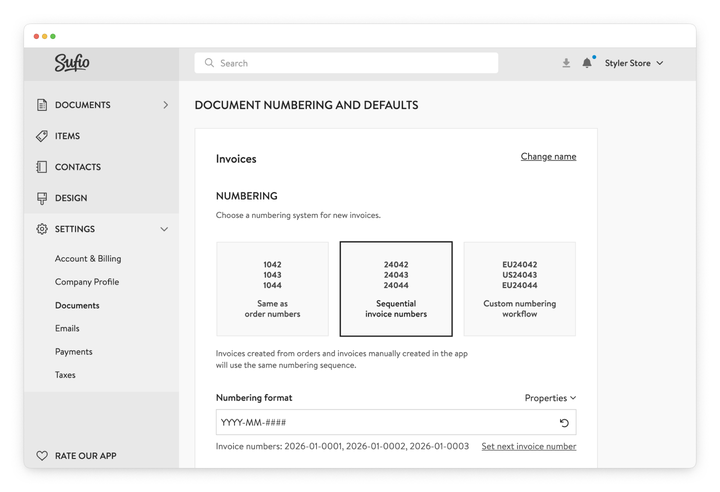
In addition, Sufio supports fully configurable sequential invoice numbering. Invoices are assigned unique, consecutive numbers in the exact order they are created, whether they originate from orders or are created manually. This helps businesses meet strict legal and accounting requirements in many countries.
You can also customize the numbering format with prefixes, dates, or order references to match local regulations or internal standards.
Invoice Falcon creates documents on demand. While it can automatically trigger emails when an order is created or paid, the document itself is generated dynamically based on the current order data at the time of the request.
This means if an order is edited—such as adding or removing products, changing quantities, or adding shipping lines—the invoice automatically updates to reflect these changes, rather than preserving the original financial record.
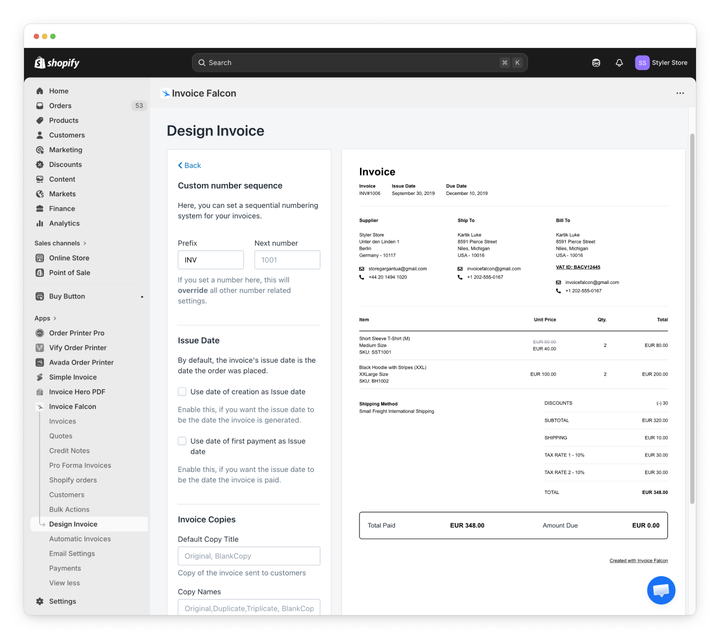
Invoice Falcon does provide sequential numbering and allows for a custom prefix and next invoice number. However, it lacks the advanced formatting options found in Sufio, such as including date properties or order references directly in the invoice number sequence.
Credit notes
Credit notes are essential for handling returns and refunds while keeping accounting records accurate.
Sufio automatically generates credit notes whenever a refund or return is processed in Shopify. These documents are kept separate from the original invoice, preserving a clear and complete transaction history.
Sufio also supports multiple types of credit notes, including cancellation credit notes and incremental (partial) credit notes.
This flexibility makes it easier to handle full cancellations, partial refunds, and more complex return scenarios while remaining compliant with accounting and tax requirements.
Invoice Falcon does not automatically create credit notes from returns or refunds in Shopify. Credit notes must be created on demand from the invoice detail view.
Furthermore, Invoice Falcon does not support distinct "incremental" or "cancellation" credit note types. The credit note document is essentially a replica of the invoice with a different title, which may not meet strict accounting standards in certain jurisdictions.
B2B support
For merchants selling to other businesses, support for Shopify B2B features is often essential.
Sufio is officially recommended by Shopify due to its native integration with Shopify B2B.
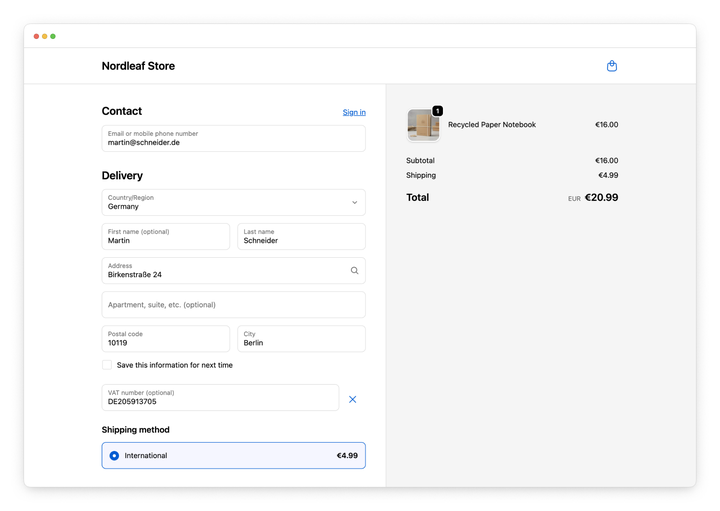
Sufio automatically handles payment terms to set due dates, displays PO numbers, and can capture and validate VAT numbers from business customers. This ensures tax exemptions are applied correctly and that all required business details appear on the final document.
Invoice Falcon supports payment terms (due dates) on invoices. However, it lacks support for other critical B2B data points.
It does not display PO numbers on documents, nor does it support capturing or validating VAT numbers from B2B company locations, which can complicate tax compliance for business-to-business transactions.
International sales
Selling internationally requires support for multiple languages, currencies, and region-specific shipping documents.
Sufio supports 40 languages with professional translations. It can automatically detect the language used during checkout and generate the invoice in that language.
It also supports multi-currency billing and provides commercial invoices that include HS codes and country-of-origin values for international shipping.
Invoice Falcon lists support for 26 languages and can also automatically create invoices in the language used by the customer. Like Sufio, it supports the creation of commercial invoices including HS codes and Country of Origin values.
However, users should verify the quality of translations for their specific target markets to ensure they meet professional standards.
E-invoicing support
E‑invoicing is becoming a legal requirement in many countries, particularly for B2B transactions. It ensures invoices follow standardized, machine‑readable formats that can be automatically validated and processed by tax authorities and business systems.
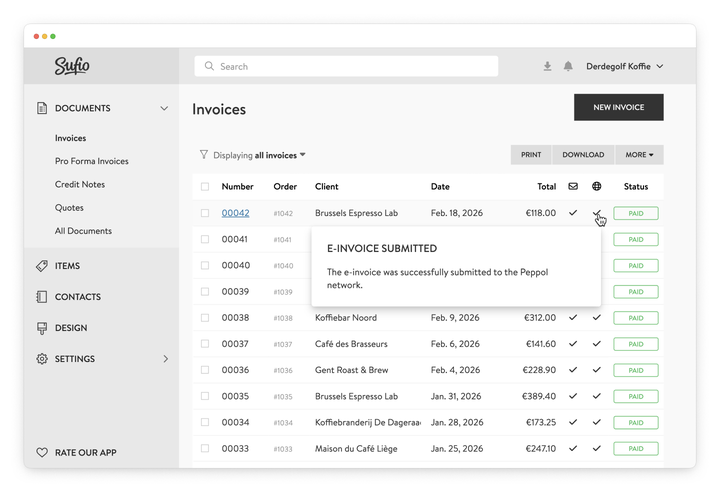
Sufio offers built‑in support for compliant e‑invoicing, helping merchants meet these legal obligations with minimal setup. It supports multiple country‑specific e‑invoicing standards, including ZUGFeRD in Germany, Factur‑X in France, and Peppol in Belgium.
In these countries, e‑invoicing is mandatory for B2B transactions. Sufio automatically generates invoices in the required format and submits them when applicable. This allows merchants to stay compliant with local regulations while continuing to use a familiar Shopify‑based workflow.
Invoice Falcon does not support e‑invoicing. Like other order printer apps, it cannot generate invoices in standardized e‑invoicing formats or submit them to national or international e‑invoicing networks.
As a result, merchants operating in countries where e‑invoicing is mandatory must rely on external tools or manual processes, increasing complexity and the risk of non‑compliance.
Design
The way your documents look is an extension of your brand identity.
Sufio offers a range of professionally designed Shopify invoice templates that can be customized using a simple visual editor.
Sufio also provides access to over 40,000 premium fonts from Monotype to ensure documents match your branding precisely.
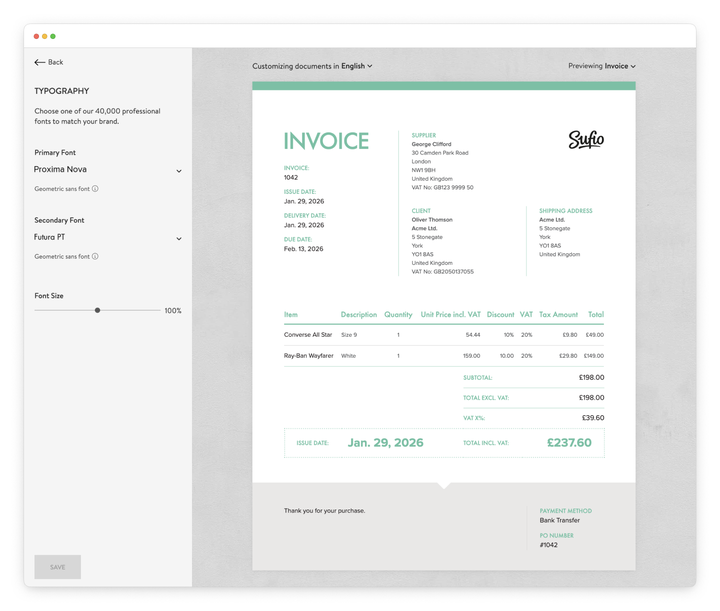
For users who want full control, the app also includes a powerful template editor—letting you customize the document layout and design, and display any order, customer, or product property directly in your documents.
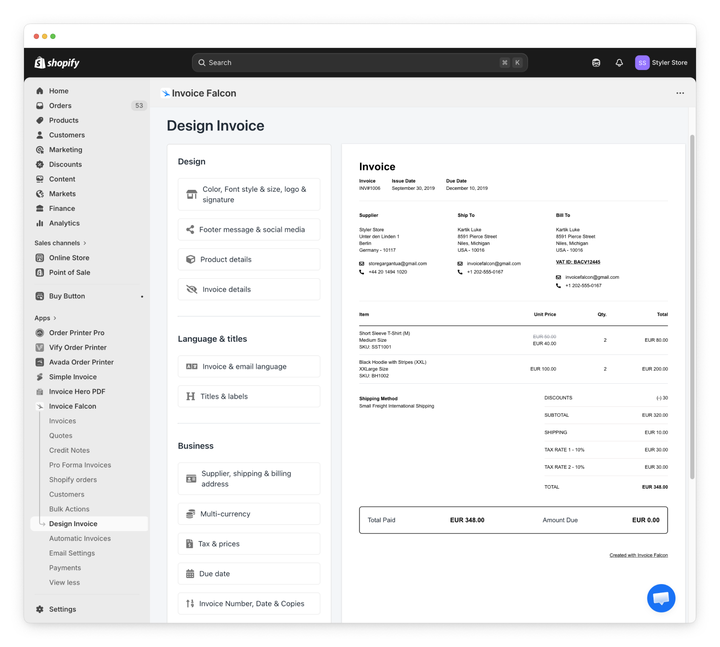
Invoice Falcon provides a visual editor for customizing document templates, allowing merchants to adjust the look and feel of their invoices.
However, it does not allow for editing the document template code directly. This limits the level of customization available for merchants or developers who require specific layout changes beyond what the visual editor offers.
Integrations
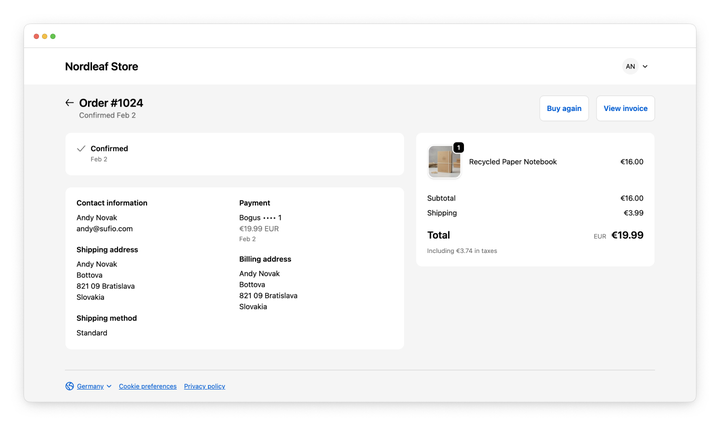
Both apps offer integration with Shopify POS, allowing you to print or send invoices directly from physical retail locations.
Sufio integrates with the new Shopify customer accounts, as well as popular email marketing platforms like Klaviyo and Omnisend. This allows merchants to include invoice download links in both marketing and post‑purchase email flows.
Invoice Falcon integrates with Shopify POS for printing or sending invoices.
It does not provide an extension for the new Shopify customer accounts or integration with email marketing apps like Klaviyo. There is no integration with Dropbox or Google Drive for automatic PDF uploads.
Pricing
Sufio offers tiered monthly plans starting at $7 for Starter (15 invoices), $19 for Growth (50 invoices), $49 for Professional (5,000 invoices), and $129 for Premium (unlimited).
All plans include a 14‑day free trial with no credit card required and prorated upgrades or downgrades.
Invoice Falcon has a simpler pricing structure. It offers a free plan that supports up to 50 invoices per month. For unlimited invoices, the "Business" plan is available for $15 per month.
Invoice Falcon is a budget-friendly option for stores with simple requirements, while Sufio’s pricing reflects its advanced features, automation, and compliance capabilities.
Summary and conclusion
Invoice Falcon is a reasonable fit if you need a lightweight, low‑cost way to generate invoices and packing slips on demand, with sequential numbering, sending triggers, and reminders, and are okay with a visual template editor.
Its workflow focuses on on‑demand document creation via the app, sending system, or customer‑facing download links in Shopify’s existing emails, rather than a fully automated invoicing system.
Sufio is the stronger option when invoices need to function as independent, compliant financial documents.
It automates invoice and credit note handling, supports overdue reminders, includes built‑in e‑invoicing support, and is designed for B2B and international sales.
If your requirements are relatively simple and budget is the primary concern, Invoice Falcon may be sufficient.
For stores moving toward B2B, cross‑border sales, or stricter compliance requirements, Sufio is built to handle that added complexity.