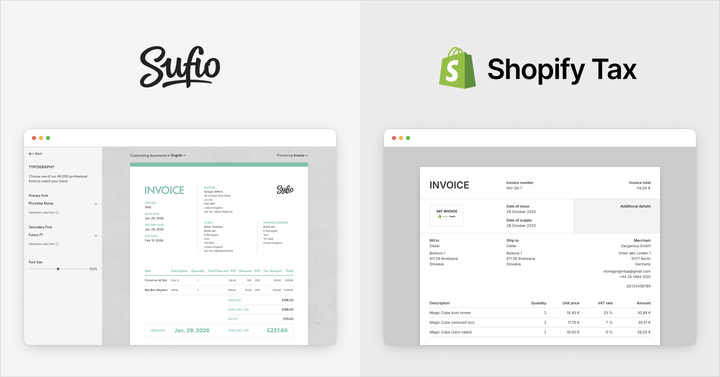
For Shopify merchants selling internationally, VAT compliance is a key consideration. Whether you’re based in the EU, UK, Australia, or further afield, proper tax invoicing ensures you meet legal requirements and maintain trust with customers.
Two tools often come into play here: Shopify Tax, a built-in feature from Shopify, and Sufio, a dedicated invoicing app trusted by over 7,500 successful Shopify merchants.
Rather than viewing these tools as competing solutions, this article explores how they complement each other to address your VAT needs effectively.
What a compliant VAT invoice actually looks like
Shopify Tax does plenty of things well, but the invoices it generates feel more like an afterthought than a real feature. For VAT purposes, it can only produce basic documents that omit key details a valid VAT invoice is legally required to include.
VAT rules are only getting more complex, and your invoices have to keep up. The EU demands detailed documentation, the UK has its own post-Brexit requirements, and that's before you factor in the rest of the world. Non-compliance means penalties, failed audits, or business customers rejecting invoices that don't meet the standard.
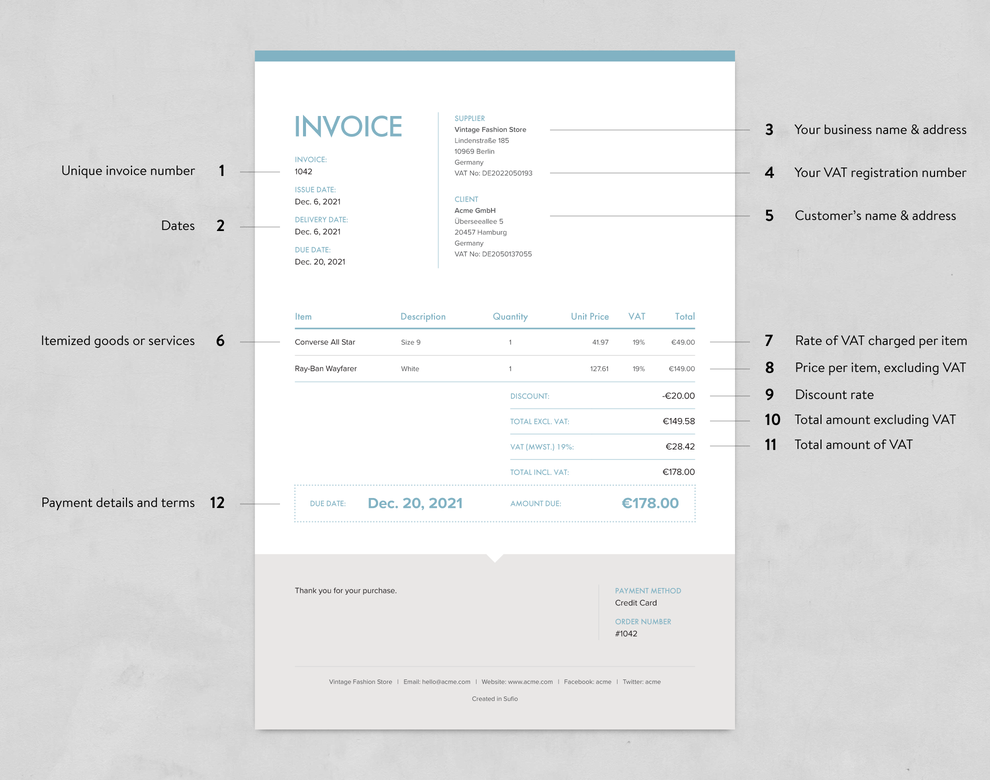
So before we go further, it helps to understand what a compliant VAT invoice actually looks like…
A valid VAT invoice must include your company and customer VAT numbers, customer information (particularly for B2B sales), a unique invoice number, issue date, itemized goods or services with applicable VAT rates, and the total amount.
These aren't optional details. They're the legal baseline for Value Added Tax invoicing in almost every country where it applies.
What is Shopify Tax?
Shopify Tax is Shopify’s integrated solution for tax compliance. It focuses on automating tax collection and providing basic reporting tools to simplify the process for merchants.
Features of Shopify Tax
Shopify Tax covers the core bases well. Here's what it brings to the table:
- Automated VAT calculations: Applies accurate tax rates at checkout across multiple regions.
- Tax reporting: Generates reports for filing in supported areas like the US, UK, and EU.
- Basic VAT invoices: Creates simple VAT invoices for the merchant.
Who should use Shopify Tax?
Shopify Tax is a solid solution for merchants who depend on reliable tax calculations—especially those selling across borders. It simplifies the process of applying accurate VAT rates at checkout and provides basic reporting, making it ideal for businesses that want to streamline tax collection without advanced setup.
The only problem is that Shopify Tax’s invoicing features are limited and often non-compliant with local invoicing legislation.
It lacks many required features, such as independent sequential numbering of invoices, the ability to create credit notes for refunds and returns, and support for e-invoicing standards.
For comprehensive VAT invoicing, pairing it with a specialized tool like Sufio ensures both accuracy and legal compliance.
What is Sufio?
Sufio is an invoicing app tailored for professional, fully compliant invoicing. Unlike Shopify Tax, which prioritizes tax collection, Sufio focuses on automatically generating invoices, credit notes, and related documents that align with global standards across all key regions.
Where Shopify Tax stops short, Sufio steps in. Here are four key areas where it makes a difference…
1. Handling of changes to an order
Shopify Tax creates a single invoice per order and does not update it or generate additional documents if the order changes.
Sufio handles order changes by creating additional documents. The original invoice remains unchanged, while refunds, returns, or order edits are recorded through credit notes or additional invoices.
This means both you and your customers always have a clear, audit-ready record of every transaction, keeping your store in line with local invoicing requirements.
2. Sequential numbering of invoices
Shopify Tax uses Shopify order numbers as invoice numbers. This creates problems when invoices are not issued in the same order as the orders themselves.
For example, in many countries, invoices should only be issued once an order is fulfilled. In online stores, some orders are fulfilled immediately while others may take days, which causes invoice numbers to fall out of sequence.
Many tax authorities require invoice numbers to be strictly sequential, reflecting the order in which invoices were created. Gaps or reordering will likely raise red flags during audits.
This is why Sufio uses an independent numbering sequence, assigning invoice numbers sequentially at the moment each invoice is created, regardless of order numbers or fulfillment timing.
3. Long-term document retention
Accounting laws in many countries require businesses to retain their invoices for up to 10 years.
Sufio stores secure copies of all issued documents for 10 years. Even if orders are deleted from Shopify or the store is shut down entirely, the invoices and credit notes remain available for accounting and legal purposes.
4. E-invoicing support
In a growing number of countries, PDF invoices are no longer sufficient because of electronic invoicing requirements. Shopify Tax does not currently support any e-invoicing standards.
Sufio supports country-specific e-invoicing standards, including ZUGFeRD in Germany, Factur-X in France, and Peppol in Belgium, and handles the electronic submission process where required, allowing merchants to meet local legal obligations without additional tools or manual steps.
Additional features of Sufio
- Automatic VAT invoicing: Creates proper VAT invoices for each order, helping you meet local invoicing regulations in the EU, UK, US, Canada, Australia, and more.
- Automated delivery of documents: Sufio can send invoices and reminders automatically via email. Customers can also download their invoices from customer account pages in the online store.
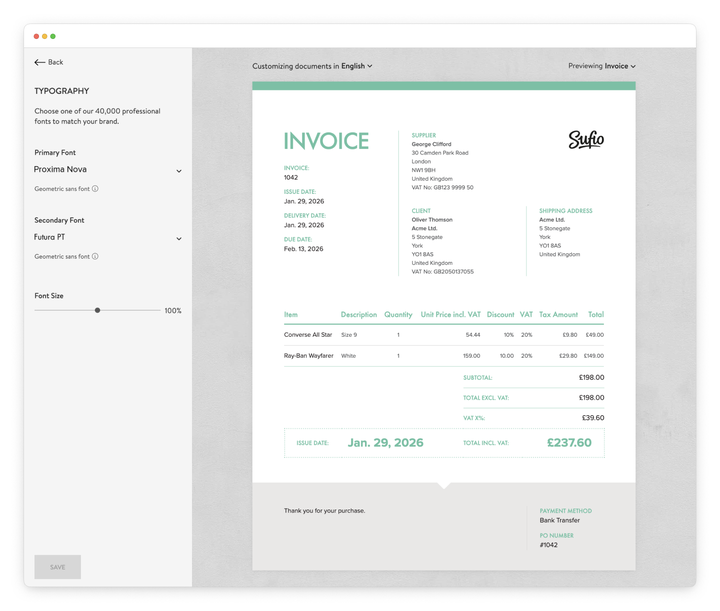
- Template customization: Allows merchants to customize their document template and create on-brand invoices that align with their website and product packaging.
- Multi-language and multi-currency support: Sufio supports 40+ languages and offers advanced multi-currency options.
- B2B functionality: Supports PO numbers on invoices, Shopify B2B companies and locations, and EU VAT number validation to set customers as tax-exempt.
Who should use Sufio?
Sufio is built for Shopify merchants needing a robust invoicing solution—particularly those selling internationally or to businesses. It excels where detailed, legally sound documentation is a must.
Shopify Tax + Sufio: A practical partnership
Instead of choosing between Shopify Tax and Sufio, consider using them together for better results. Here’s how they fit:
- Shopify Tax manages tax collection: It calculates VAT at checkout and provides basic reporting, leveraging its tight integration with Shopify for a seamless start.
- Sufio makes invoicing compliant: Post-sale, Sufio takes over and generates professional, compliant invoices automatically. Whether you need to handle reverse charges for EU B2B clients or create multi-language invoices for global buyers, Sufio fills the gaps with automation and precision.
- The outcome: Shopify Tax handles the upfront tax work; Sufio ensures your invoices meet every legal requirement. This combination removes any manual effort on your part and keeps your store compliant in almost every region.
Take an EU merchant selling to both consumers and businesses across the EU:
Shopify Tax handles collecting the correct VAT at checkout, while Sufio automatically generates compliant VAT invoices and delivers them to customers, including submitting them via e-invoicing networks if required.
It’s a streamlined approach to what is otherwise a complex challenge.
Conclusion
VAT compliance is non-negotiable for Shopify merchants selling to businesses or internationally, but it doesn’t have to be complicated.
By combining Shopify Tax with Sufio, you get a complete solution: accurate tax collection at checkout and automatic, compliant invoicing.
Shopify Tax handles the calculations, and Sufio ensures your invoices meet local regulations. Together, they let you focus on growing your business with confidence that your tax obligations are fully covered.