France is one of several European countries moving to mandatory structured e-invoicing, starting with domestic B2B sales.
Factur-X is one of the supported formats, combining a readable PDF invoice with structured XML data in a single file.
Sufio is an invoicing app for Shopify with built-in e-invoicing for French stores. It can embed Factur-X data in your invoices and credit notes without changing how your PDFs look, and it can submit eligible B2B e-invoices in UBL through an approved platform.
You don't have to wait for your e-invoicing obligation to start. Switch on Factur-X now and keep sending invoices exactly as you do today.
In this article, we will discuss:
Summary
- Factur-X is a hybrid format. A single file works as a readable PDF for your customer and as structured data that compatible accounting software can process automatically.
- Sufio embeds it automatically. Turn on one setting, and your invoices and credit notes carry Factur-X data without any change to how your PDFs look.
- The format alone is not the whole obligation. Once your business must issue e-invoices, those invoices also have to go through an approved platform, which Sufio handles in UBL.
Factur-X is a hybrid e-invoice format. A single file works both as a readable PDF invoice and as structured data that software can process automatically.
Your customer opens the document as a regular PDF, while compatible accounting software extracts the invoice data embedded inside it without any manual entry.
Factur-X is based on the European e-invoicing standard EN 16931 and follows the same model as ZUGFeRD, the format used for e-invoices in Germany.
France accepts three e-invoice formats: UBL, CII, and Factur-X.
UBL and CII are pure XML with no visual layer. The formats can only be read by software, or by a person after conversion. They are built for systems that exchange invoices automatically from end to end.
The practical difference is who can read the file. A UBL or CII invoice needs compatible software at both ends, while a Factur-X invoice stays readable by anyone who receives it.
All three carry the same invoice data and follow the same European standard. The format does not change what your invoice must contain, only how the data is packaged.
Sufio supports both Factur-X and UBL: it embeds Factur-X data in your PDF invoices and credit notes and uses UBL when submitting e-invoices through an approved platform.
A Factur-X invoice looks like any other PDF, but it carries a second, invisible copy of the invoice inside it.
That copy is an XML file attached to the document. It contains the same information your customer sees on the page: your details and theirs, line items, tax rates, totals, and payment information.
Because the data travels inside the PDF, there is still only one file to send, store, and archive. Your customer receives a normal invoice, and their accounting software can read the data without anyone retyping it.
This is possible thanks to PDF/A-3, an archival PDF standard that allows files to be attached inside a document.
When Sufio creates an invoice or credit note for a store based in France, it generates the PDF document and embeds the corresponding XML data inside it.
The appearance of the document does not change, and you can download or send it exactly as before.
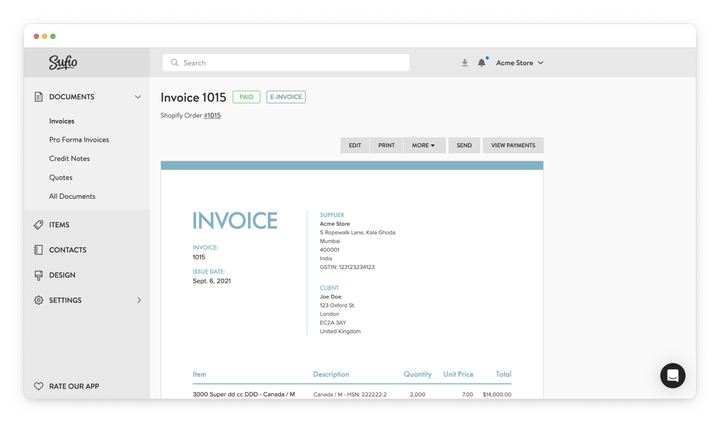
When a document contains embedded XML data, an e-invoice badge appears in its online view.
To embed Factur-X data in your PDF invoices and credit notes:
- Go to the Settings → Documents page in your Sufio account.
- Scroll down to the E-invoicing section.
- In the Factur-X data in PDF invoices card, turn on the toggle.
- Click Update settings to save your changes.
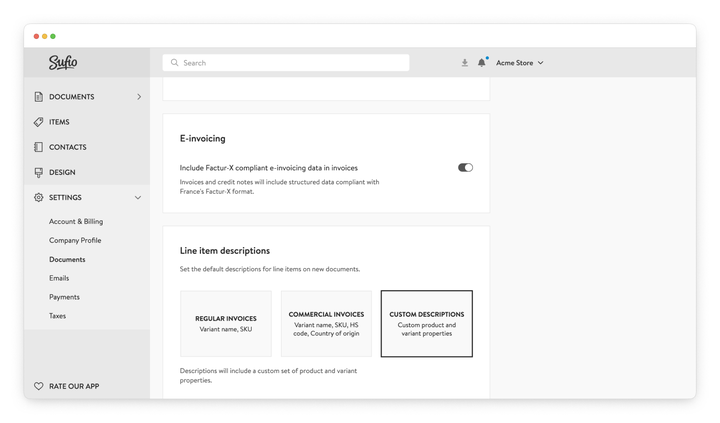
Sufio will embed structured Factur-X data in invoices and credit notes created for your store.
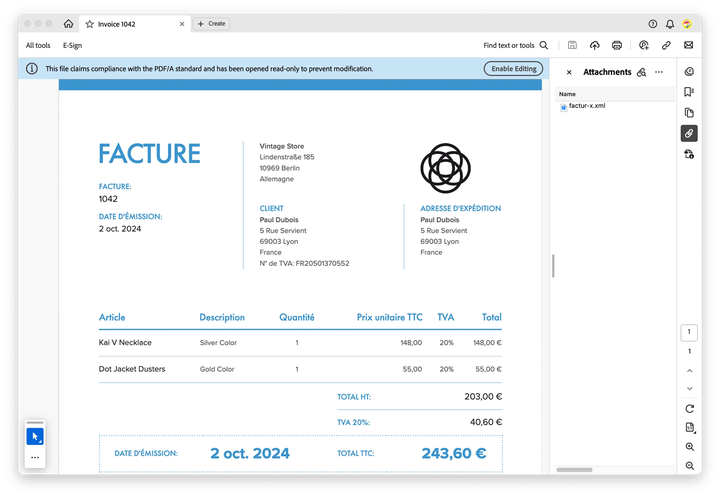
The XML file is included as an attachment inside the PDF/A-3 document.
To view it, download the invoice or credit note and open it in a PDF reader that supports attachments, such as Adobe Acrobat.
Some browser-based PDF viewers do not display embedded attachments. If you cannot see the XML file in your browser, open the downloaded document in a compatible PDF reader.
The invoice format and the way it is delivered are two separate requirements.
Factur-X defines the format of your document, but it does not deliver the e-invoice to your customer or report the transaction to the French tax authority (DGFiP).
Once your business is required to issue e-invoices, those invoices must also be exchanged through a Plateforme Agréée (PA).
Until then, you can send Factur-X PDFs directly to your customers and prepare your store for the change.
Sufio handles these two requirements through separate settings:
| Sufio setting | What it does | |
| Factur-X data in PDF invoices | Embeds structured XML data in PDF invoices and credit notes. | |
| E-invoicing via French PA | Submits eligible B2B e-invoices through an approved platform using UBL. |
You can enable both settings at the same time. The PDF will contain Factur-X data, and the corresponding e-invoice will be submitted separately through an approved platform.
No. Factur-X is one of the three e-invoice formats supported in France, alongside UBL and CII.
Businesses can use any supported format that is compatible with their e-invoicing workflow and approved platform.
Not once your obligation to issue e-invoices begins. Sending a Factur-X PDF directly by email does not replace the requirement to exchange domestic B2B e-invoices through an approved platform.
Sufio covers both requirements: it embeds Factur-X data in your PDF documents and submits eligible B2B e-invoices through an approved platform, without changing how you work in Shopify.
Sufio can include Factur-X data in invoices and credit notes created for accounts based in France.
Yes. Sufio can embed Factur-X data in a PDF document and submit the corresponding e-invoice through an approved platform.
Sufio uses UBL for e-invoices submitted through an approved platform. This lets you keep a readable Factur-X PDF for your customer while meeting the separate submission requirement for eligible domestic B2B e-invoices.