The EU's New €3 Customs Fee: What It Means for Non-EU Shopify Stores
As of July 1, 2026, the European Union has abolished its long-standing duty-free exemption on low-value imports. In its place, a temporary flat €3 customs duty now applies to goods shipped from outside the EU to consumers within it.
For non-EU Shopify merchants selling to European customers, this is a significant shift. Orders that previously crossed borders duty-free are now subject to customs charges, new data requirements, and stricter compliance expectations.
In this post, we'll break down exactly what's changed, why the EU made this move, and what you need to do to keep your Shopify store compliant. We'll also look at how dedicated invoicing apps like Sufio can help you generate the exact documentation that customs authorities now expect on every shipment.


Expand with confidence. Sufio invoices are compliant in over 50 countries and available in 40+ languages.
Start a free trialWhat changed on July 1, 2026
Until June 30, 2026, goods imported into the EU in consignments with an intrinsic value of €150 or less were completely exempt from customs duties. This was known as the “de minimis” exemption, originally designed to spare customs authorities the administrative burden of processing duties on small parcels.
That exemption is now gone. Under Council Regulation (EU) 2026/382, a temporary flat €3 customs duty per item applies to all low-value consignments (up to €150) sold in distance sales to EU consumers.
The measure is set to remain in place until July 1, 2028, when the EU Customs Data Hub for ecommerce is expected to go live and normal customs duties based on product classification will take over.
It's worth noting that this change only affects customs duties. Import VAT on low-value goods was already required since 2021, so if you've been using IOSS to collect VAT at checkout, that part of your setup remains unchanged.
Why the EU made this change
According to the European Commission, nearly 5.9 billion low-value items were shipped directly from non-EU countries to EU consumers in 2025, up from 1.3 billion in 2022. About 90% of these parcels originated from China, with platforms like Temu and Shein driving much of the growth.

The Commission argues that the old de minimis rule, while sensible when it was introduced, had become a competitive loophole. EU-based retailers pay customs duties on the goods they import and sell. Non-EU sellers shipping directly to consumers did not. The result was an uneven playing field that the Commission says contributed to “the decline of traditional retail and the desertification of cities, affecting local jobs and community life.”
Safety is the other major concern. EU-wide inspections carried out across all 27 member states in 2025 found that over 60% of checked low-value imported products failed EU safety standards. Cosmetics and toys were the worst offenders, with 65% of imports in both categories falling short due to missing labels, forbidden ingredients, or absent safety documentation.
The €3 duty is the EU's first step toward bringing all imports, regardless of value, into the same customs framework. It's also explicitly described as non-discriminatory because the same rules apply to all countries of origin and all logistics operators.
How the €3 duty is calculated
The €3 charge applies per item, not per parcel. But “item” here doesn't mean each individual product in the box. It means each unique tariff classification (HS code) in the customs declaration.
Here's how the European Commission illustrates it:
| Example consignment | Customs duty | |
|---|---|---|
| 5 T-shirts | €3 (1 tariff line) | |
| 1 T-shirt + 1 watch | €6 (2 tariff lines) |
So if a customer orders five T-shirts, that's one tariff classification and one €3 charge. But if they order a T-shirt and a watch, those fall under two different HS codes, and the duty doubles to €6.
Tip
Don't assume identical products will always be grouped into a single €3 charge. As Avalara notes, grouping depends on how your carrier or customs broker declares the goods, so it’s worth asking them how your consignments will be filed.
Who pays the duty
The European Commission has been explicit on this point: the €3 customs duty is charged to the business, not the consumer. Specifically, it's owed by the declarant, which is typically the seller, the importer of record, the IOSS holder, or their indirect representative.
That said, the practical reality depends on your shipping setup and Incoterms:
- DDP (Delivered Duty Paid): You handle duty at checkout or absorb it into your pricing. The customer pays nothing extra on delivery.
- DAP (Delivered at Place): Duties and fees are collected from the customer upon delivery, usually by the carrier. While the EU frames the €3 as a charge on businesses, under a DAP arrangement, the cost still flows to the buyer in practice.
If you're already using DDP for your EU shipments, the €3 becomes another line item in your landed cost calculations. If you use DAP, your customers may start seeing small customs charges on deliveries that were previously duty-free. Either way, it's worth revisiting your approach.

What this means for non-EU Shopify stores
If you ship physical goods from outside the EU to customers within it, this change affects you regardless of your store's size, your product category, or the VAT scheme you use. Here's what's different:
Every low-value parcel is now dutiable. There is no longer a threshold below which goods enter the EU without customs duties. Even a single €1 item shipped from outside the EU is subject to the €3 charge.
Data quality matters more than ever. Customs authorities now expect accurate HS codes, country of origin, declared values, and (starting November 1, 2026) product identifiers on every shipment. Vague product descriptions like “accessories” or “goods” won't cut it anymore.
Non-IOSS shipments must clear customs in the destination country. As of July 1, 2026, non-IOSS B2C shipments valued at €150 or less must clear customs in the destination member state. They can no longer be centrally cleared and then transported onward. This can affect delivery times and carrier routing.
Returns become more complex. With more shipments incurring duty, returned goods may qualify for duty refunds. But the process varies by member state and requires proper documentation of the original duty payment. If you sell in high-return categories like fashion or electronics, confirm the refund process with your customs broker.
The impact on dropshippers
The new rules will likely hit dropshippers the hardest. If your supplier ships directly from outside the EU to your EU customers, every individual order now incurs the €3 customs duty on top of any VAT obligations you're already managing.

For stores selling low-ticket items, the math gets painful fast. A €3 duty on a product priced at €5 effectively increases the landed cost by 60%. Multiply that across mixed-category orders and slim dropshipping margins, and the impact on profitability is difficult to ignore.
If you run a dropshipping store, it's worth reviewing how VAT already interacts with your business model, especially when your store, supplier, and customers are in different countries. Our VAT guide for Shopify dropshipping stores walks through these scenarios in detail.
The new customs duty adds another layer on top of those VAT obligations. Some dropshippers are responding by exploring EU-based fulfillment or warehousing, which allows goods to enter the EU in bulk (subject to standard commercial duties) and then ship to customers domestically, avoiding the per-parcel €3 charge entirely. That strategy has its own compliance implications, including potential VAT registration obligations in the member state where you hold inventory, but it may be worth considering if you have stable EU demand.
How Shopify handles the new duty
Shopify has already updated its systems to support the €3 duty. How it works in practice depends on your store's setup:
| Your setup | What happens | Action needed |
|---|---|---|
| Managed Markets | The €3 duty is calculated, displayed, and collected at checkout automatically. Global-e remits the duty. | No action required. |
| Duties and import taxes activated | Orders already route through duty calculation at checkout. The configuration has been updated to include the €3 fee. | Confirm duties are activated for EU countries in Settings > Taxes and duties. |
| IOSS only (no duties) | IOSS handles VAT at checkout, but not customs duties. The €3 duty will be charged to your customer at delivery. | Consider activating duties for the EU to collect the fee at checkout. |
| No duties, no IOSS | Both VAT and the €3 duty are charged to your customer at delivery. | Consider registering for IOSS and activating duties. Learn more. |
If you use Shopify Managed Markets, you're essentially covered. For everyone else, it's worth reviewing your tax and duty settings before your next EU order ships.
New product identifier requirements
Beyond the €3 duty itself, the EU is introducing mandatory product identifiers (PIDs) for all goods in low-value consignments. These can be declared voluntarily as of July 1, 2026, and become mandatory on November 1, 2026.
Three identifiers are required:
- A merchant identifier: Your internal product code, such as an SKU or item number.
- A non-standardized manufacturer identifier: A code assigned by the manufacturer or supplier for that specific product.
- A standardized manufacturer identifier: An industry-standard code like a barcode (EAN, UPC, or ISBN), if the product carries one.
These identifiers flow into the customs declaration, so they need to be captured in your product data and passed to your carrier or customs broker. The goal is to help customs authorities trace products and block unsafe or non-compliant goods at the border.
What you need to do as a merchant
Here's a practical checklist for non-EU Shopify merchants selling to EU customers:
- Assign accurate HS codes to every product. In your Shopify admin, go to any product, click Shipping, and enter the HS code in the Customs information section. You can also update multiple products using the bulk editor or a CSV upload. The €3 duty is calculated per tariff classification, so getting this right directly affects the charges.
- Confirm your country of origin data. Every product should have a country of origin declared. Customs authorities use this alongside the HS code to process your shipments.
- Prepare your product identifiers. Start collecting SKUs, manufacturer codes, and barcodes now. Even though PIDs are voluntary until November 2026, having them ready avoids a last-minute scramble.
- Review your duties setup in Shopify. If you're only using IOSS, consider activating duties for the EU so you can collect the €3 fee at checkout rather than surprising customers at delivery.
- Update your shipping policies and checkout messaging. Make it clear whether duties and import taxes are included in the checkout price (DDP) or will be collected upon delivery (DAP). Transparency here prevents refund requests and negative reviews.
- Talk to your carrier or customs broker. Confirm how your shipments will be declared, whether identical products will be grouped on a single declaration line, and how they're handling the new requirements.
- Review your EORI number. If your business is the importer of record, you need an EORI number from the customs authority of the first EU country your goods enter. If the customer is the importer of record, the carrier typically handles it.
The importance of accurate commercial invoices
With the de minimis exemption gone, customs authorities will scrutinize every low-value shipment entering the EU. The commercial invoice is the document they rely on to determine a shipment's value, classify its contents, and calculate duties.
For DDP shipments, they also verify that pre-paid duties match the declared values. An incomplete or inaccurate invoice can mean delays, additional inspections, or rejected shipments.
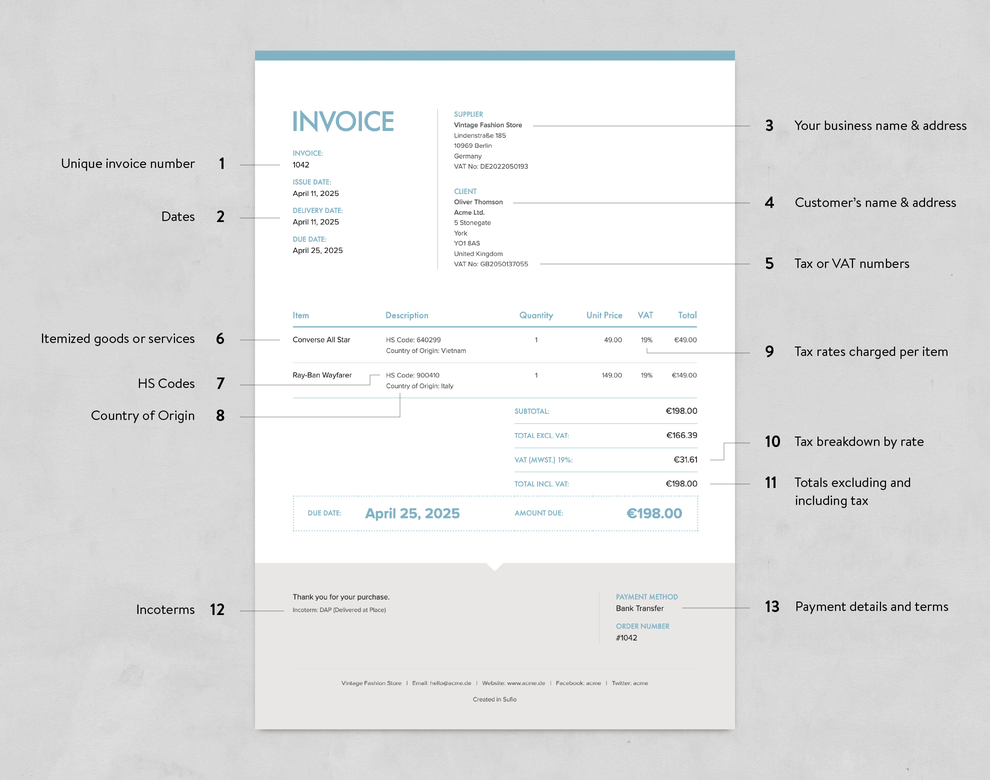
A proper commercial invoice for Shopify includes everything found in a standard invoice (seller and buyer details, product descriptions, quantities, unit and total prices, tax amounts, etc.) plus trade-specific information like HS codes, country of origin, and Incoterms.
Most carriers can generate a basic commercial invoice from your shipment data, and some order printer apps can produce one if you're willing to add custom code to your templates. Sufio handles it as part of a complete invoicing workflow:
- Commercial invoices with the details customs needs. Sufio's commercial invoices include HS codes and country-of-origin values, so the information customs officers look for is already on the document.
- Invoices that stay valid after the order changes. Sufio stores invoices as independent financial documents rather than regenerating them from live order data. If you refund an item or edit an order, the original invoice stays untouched, and Sufio issues a credit note instead. That leaves a clean audit trail for your accountant and for customs.
- Ready for cross-border selling. Invoices in 40+ professionally translated languages, generated automatically in the language your customer used at checkout, plus multi-currency billing, sequential numbering, and built-in e-invoicing support for standards like ZUGFeRD in Germany, Factur-X in France, and Peppol in Belgium. Sufio supports thousands of merchants in over 100 countries.
As EU customs tightens its grip on low-value imports, clean and accurate documentation stops being paperwork and starts being part of how quickly your parcels clear the border.
What's coming next
The €3 duty is a transitional measure. Here's the timeline to keep in mind:
- July 1, 2026: The €3 customs duty takes effect. Product identifiers can be declared voluntarily.
- November 1, 2026: Product identifiers become mandatory on all low-value consignment declarations.
- Autumn 2026 (date TBD): The EU may introduce a separate “Union handling fee” to cover customs processing costs. The amount and start date have not been finalized.
- July 1, 2028: The EU Customs Data Hub for ecommerce goes live, and normal customs duties based on product classification replace the flat €3 rate.
It's also worth noting that the UK has not made equivalent changes yet. The UK maintains its own £135 low-value import threshold, under which goods are exempt from UK customs duty (though UK VAT still applies at the point of sale). The UK Treasury has announced it will start charging import duties on small parcels worth less than £135 from October 2028. If you sell to both markets, you'll need to manage each regime separately.
Conclusion
The end of the EU's de minimis exemption is one of the biggest changes to hit cross-border ecommerce in years. For non-EU Shopify merchants, every parcel shipped to an EU customer now carries customs obligations, regardless of value.
The good news is that the steps to stay compliant are straightforward: assign accurate HS codes and country of origin data, prepare your product identifiers, review your duty collection setup in Shopify, and make sure your commercial invoices are compliant.
Getting the paperwork right won't make the new rules go away, but it will keep your parcels moving and your EU customers free from surprise charges at the door. That's worth more than any workaround.