Top 10 Shopify Podcasts for Agency Owners in 2026

Podcasts have become an efficient way for Shopify agencies to learn without spending hours reading long-form content. They cover platform updates, industry news, and emerging trends, and they often bundle it all into one regularly scheduled show.
Running a Shopify agency means more than building stores. You also need to keep up with what's changing in the industry, stay on top of the laws and regulations in your region, and know which apps to recommend to merchants.


Podcasts make that easier: you can listen while you work, during your commute, or between meetings, and you hear directly from founders, developers, marketers, and operators about what worked, what didn't, and what they learned along the way.
We've selected ten Shopify podcasts worth following in 2026, covering development, growth, and ecommerce strategy, with useful picks for different roles across an agency.
1. Shopify Masters
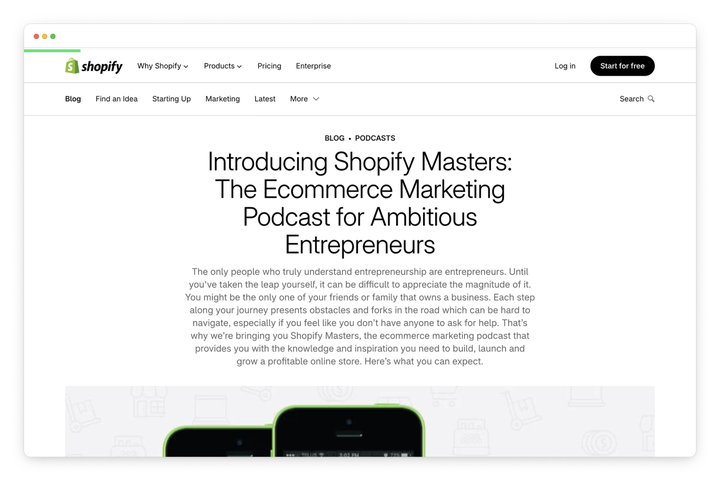
This is Shopify's own podcast.
Shopify Masters has been running since 2016 and has published more than 800 episodes. Each episode follows the same format: a founder tells the story of their company from the very beginning.
Topics include:
- How specific brands grow from zero to scale
- Supply chain, manufacturing, and inventory decisions
- Acquisition channels that worked for individual brands
- Financing decisions, from bootstrapping to outside funding
Episodes are sorted by category, so before pitching a merchant, you can hear how a founder in their industry built their business.
Most episodes run 30–40 minutes.
A good place to start is the Avocado Green episode, where Vy Nguyen explains how he took over his father's mattress factory and spent 15 years building his own supply chain instead of raising outside money.
2. The Unofficial Shopify Podcast
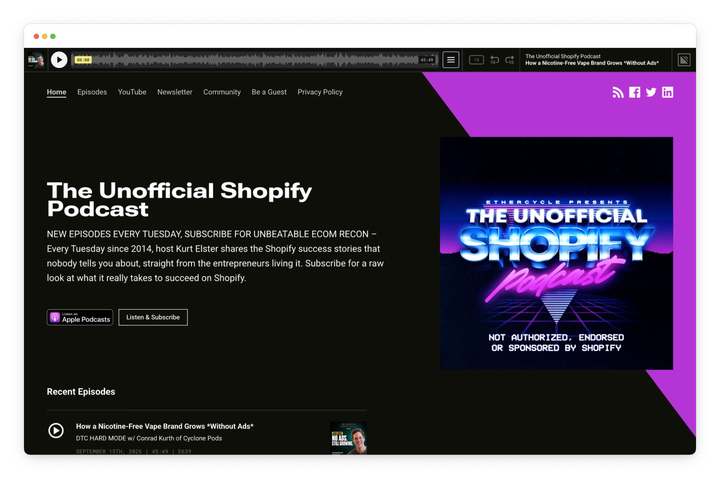
At the other end of the spectrum is The Unofficial Shopify Podcast, produced by Ethercycle, a Shopify Plus agency near Chicago.
While Shopify Masters focuses on founder stories, this podcast gets into Shopify releases, theme customization, and the tools and apps agencies actually use.
Host Kurt Elster works directly with Shopify stores, so the show often approaches topics from an implementation perspective rather than a purely strategic one.
New episodes are released every Tuesday, and the show has published more than 600 of them.
Topics most relevant to agencies and developers include:
- Shopify platform releases and how they affect builds
- Merchant interviews backed by real numbers
- Shopify theme work and conversion optimization, with the reasoning explained
- Original data from Ethercycle's client base
Episodes run around 45 minutes, with enough time to go deeper into one topic.
3. Liquid Weekly Podcast
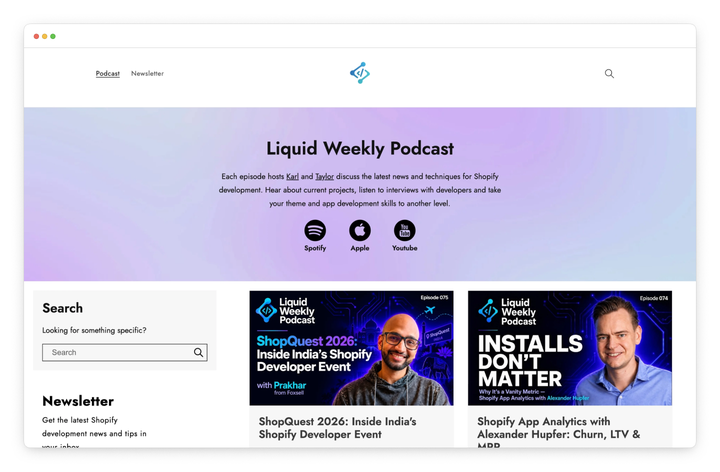
For a more technical perspective, Liquid Weekly focuses on Shopify development: platform changes, new APIs, and the tools developers use to build on Shopify.
The show has published more than 75 episodes, with recent topics including:
- Shopify APIs, Liquid, and development tools
- Theme and app development
- Shopify changelog updates
- AI-assisted development workflows
- Developer interviews and community discussions
- Changes affecting Shopify Partners
It's most useful for developers and technical leads rather than marketing teams.
Episodes alternate between practical development discussions, guest interviews, and analysis of recent platform updates. Shopify product managers also appear regularly to explain new releases.
4. Operators
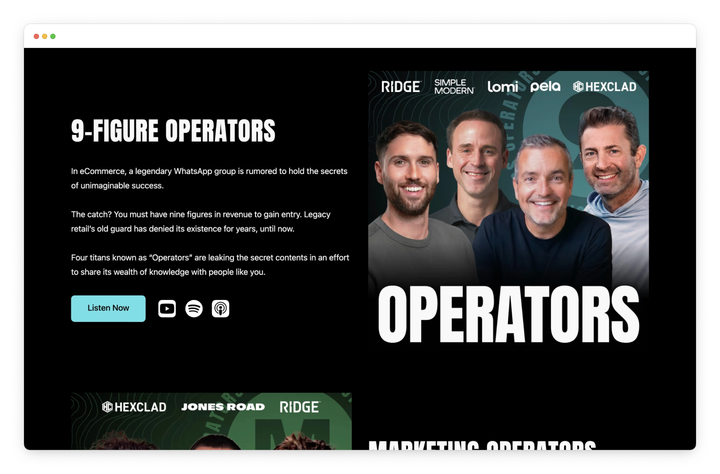
Operators is a podcast about running a consumer brand at scale. It's less about how to build an online store and more about the decisions that come after: how much to spend on advertising, which channels to sell through, how to price products on Shopify, and when to expand internationally.
It's hosted by four founders who run consumer brands themselves, rather than people who advise them: Sean Frank (CEO of Ridge), Jason Panzer (President of HexClad), Mike Beckham (CEO of Simple Modern), and Matt Bertulli (founder of Pela Case and Lomi). They rotate, so most episodes feature two or three of them rather than all four.
Common topics include:
- Advertising measurement and attribution
- Channel mix across Meta, YouTube, Amazon, TikTok Shop, and physical retail
- Pricing, margins, tariffs, and international expansion
- Practical uses of AI across consumer brands
- Founder finances and selling a DTC business
Episodes usually run 45–75 minutes and often get into the numbers behind each decision.
5. eCommerce Fastlane
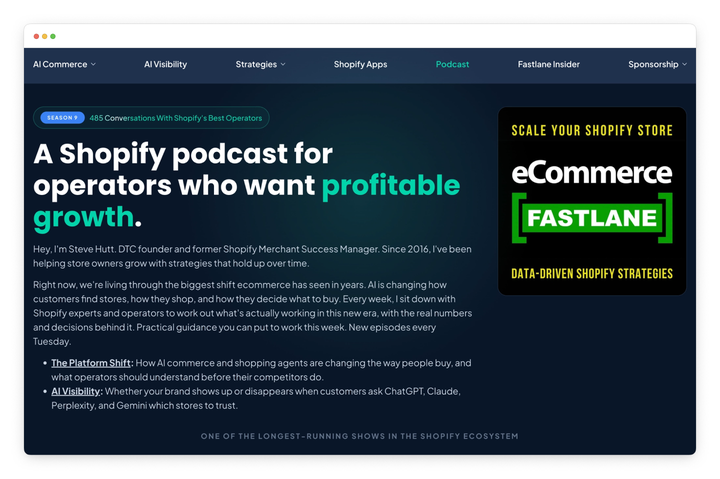
The eCommerce Fastlane podcast covers the software merchants add on top of Shopify and the decisions that come with it, from subscriptions, email and SMS, and reviews to search, merchandising, analytics, tax, and shipping.
Episodes typically feature a conversation with the founder or an executive of one of these companies.
The interview format is consistent. The host asks what problem the product was built to solve, how it works, and which stage of growth it's best suited to. He also often presses for context on where the advice applies, like whether it's for a store doing $50,000 a month or $1,000,000 a month.
Host Steve Hutt co-founded and exited an optical DTC brand, then spent six years at Shopify as a Merchant Success Manager. He started the podcast in 2018 and has published more than 470 episodes.
Episodes average 39 minutes. Recent recurring threads include:
- Agentic commerce and visibility in ChatGPT and Google AI Mode
- Attribution gaps between Meta, Google, and Shopify analytics
- Profitability problems that can look like growth problems
- Retention benchmarks and revenue per email subscriber
6. The Shopify App Show
The Shopify App Show covers independent app developers in the Shopify ecosystem: what they built, why they built it, and which problems their products solve.
Host Martin Cox—a 14-year Shopify ecosystem veteran—likes to skip the sales pitch. Each episode is a short conversation with the founder about how the product actually works.
Episodes run 20–35 minutes and cover topics such as:
- Self-optimizing storefronts and automated CRO
- Merchandising and product data quality
- How apps work with agencies and influencers
- Consent and privacy compliance
- Subscriptions and recurring billing
For agencies, it’s a useful way to discover apps beyond the biggest names in the Shopify App Store.
7. Limited Supply
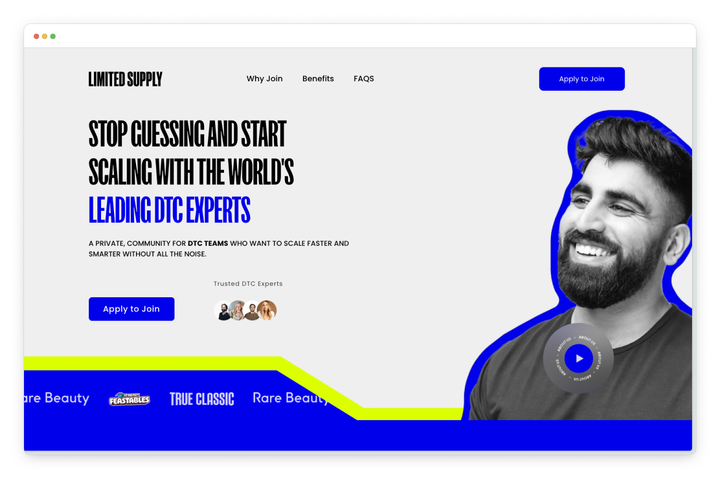
Limited Supply is a podcast focused on the business behind consumer brands.
The show covers industry developments, breakdowns of brands that failed, and why co-host Nik Sharma invests his own money in some of the companies he covers. Sharma shares hosting duties with Moiz Ali, who founded the deodorant brand Native and sold it to P&G in 2017.
Sharma founded the consultancy Sharma Brands, which helped consumer brands with launches and growth strategy, from positioning and offer design to landing pages and creator partnerships. Its client list included Everlane, HexClad, Jolie, Bacardi, Chamberlain Coffee, and Feastables. In late 2025, Lunar Solar Group acquired the firm, and Sharma now serves as its Chief Growth Officer.
Sharma worked with many of these brands during their launches, so much of the advice on the show comes from projects he was directly involved in.
Episodes generally come in three formats:
- Interviews with operators and brand executives
- Solo episodes on growth, landing pages, and AI workflows
- Talks recorded live at industry conferences
The show has published more than 190 episodes. A new episode is released every Wednesday, and most run for around 45 minutes.
8. Winning With Shopify
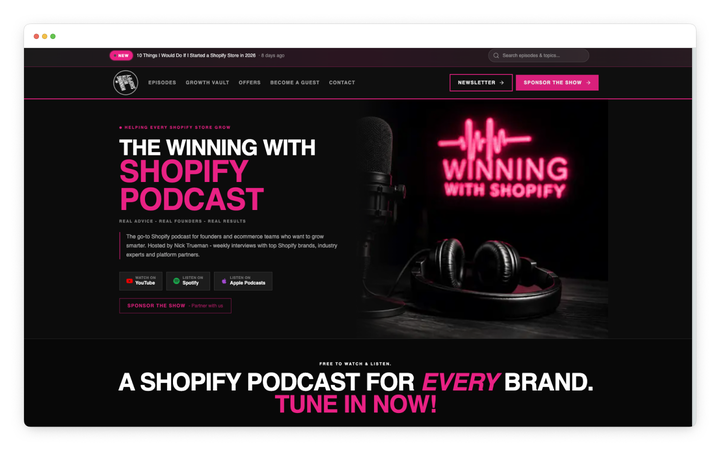
Winning With Shopify is an interview podcast, but its guest list goes beyond founders to include growth specialists, app creators, and Shopify partners.
Host Nick Trueman has worked in digital marketing since 2007 and runs Spec Digital, a UK agency specializing in paid search and SEO.
Two episodes are released each week. Shorter ones, called ‘Tea Break Talks,’ cover Shopify updates and practical tactics, while longer ones feature interviews or deeper dives into specific topics.
The discussions usually cover:
- Shopify SEO and technical optimization
- Paid search and advertising performance
- Email marketing and customer retention
- Inventory, returns, and other operational challenges
- AI tools and Shopify workflows
- Founder stories and business growth
With more than 400 episodes, the show spans beginner basics and more advanced Shopify strategy, so it's useful at different stages of an agency's growth or for recommending to merchants at different levels.
9. eComFuel Podcast
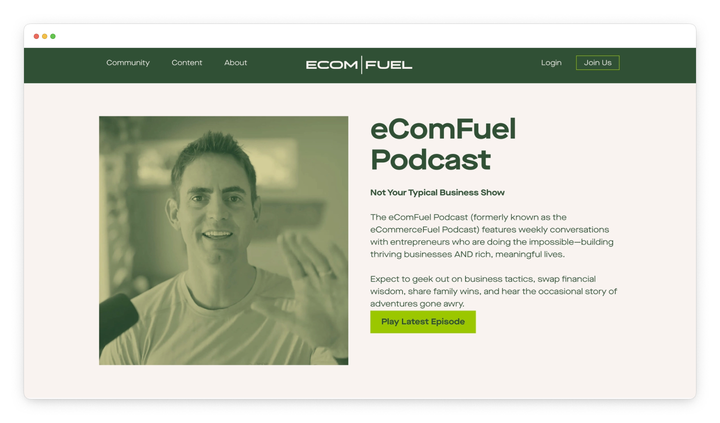
The eComFuel Podcast focuses more on running an ecommerce business than managing the storefront itself.
Host Andrew Youderian founded eComFuel, a private community for owners of seven- and eight-figure ecommerce businesses. He has hosted the podcast since 2013.
New episodes are released weekly, often on Fridays. Most run 45–60 minutes, although solo episodes can be much shorter.
Common topics include:
- Selling and exiting ecommerce businesses
- Hiring, delegation, and team management
- Funding and cash flow
- AI and business automation
- Personal finance for business owners
- Paid acquisition and advertising
eComFuel also publishes an annual benchmark report based on data from around 300 store owners, broken down by revenue tier and business model. The podcast regularly draws on this data when discussing performance and trends.
10. The Shopify Solutions Podcast
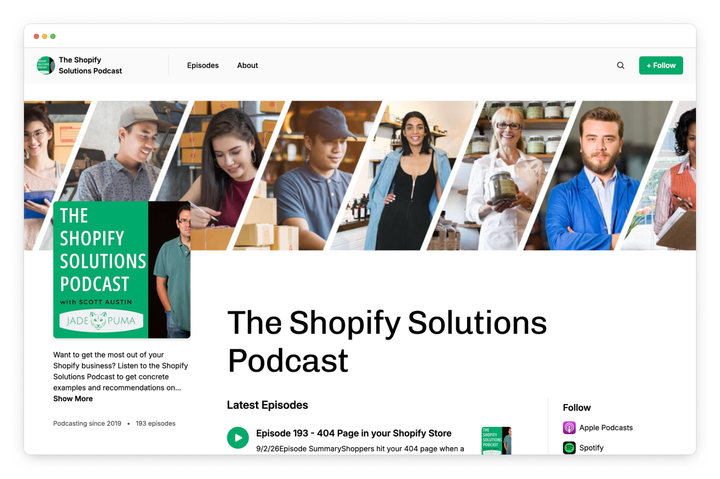
The Shopify Solutions Podcast focuses on implementation: what to change in a Shopify store and how to do it.
Host Scott Austin founded JadePuma, a Shopify agency in San Diego that works mainly with smaller and early-stage stores. Most episodes are solo, with examples drawn from recent client projects.
New episodes are released roughly every two weeks. Solo explainers usually run 11–30 minutes, while store audits and guest interviews run up to about 50 minutes.
Common topics include:
- Shopify platform changes and their impact on stores
- AI search and Answer Engine Optimization
- SEO and user experience
- Store audits and conversion issues
- Themes, Liquid, and custom development
- Accessibility and compliance
The show has published more than 190 episodes since 2019. It's particularly useful for implementation teams, with practical ideas developers can use and account managers can bring back to clients.