Get your Shopify store ready for e-invoicing in Slovakia
Sufio automatically creates invoices and credit notes with structured data, so your Shopify store is ready for mandatory e-invoicing from January 2027.
Trusted by 7800+ Shopify merchants
Sufio supports thousands of Shopify and Shopify Plus merchants in over 100 countries.
Whether you’re about to launch your first online store or you’ve just reached 1 million orders, our powerful invoicing automation and compliant documents will bring peace of mind and leave you time to focus on the most important part of your business—growth.




PDF invoices are no longer enough in Slovakia
From January 1, 2027, PDF invoices between businesses in Slovakia are no longer enough.
Invoices will be sent as structured e-invoices through the Peppol network, and their data also goes to the Financial Administration.
-
01
Create PDF invoice
Generated as a simple PDF document in an unstructured format
-
02
Email to customer
Sent directly from merchant to buyer, with no intermediary
-
03
No validation
No automated checks, no visibility for the government
-
04
Manual processing
Processed by hand and reported to the tax authority
-
01
Create structured e-invoice
Generated automatically in the Peppol format required by law
-
02
Send through the Peppol network
Sent through a digital postman, a certified provider
-
03
Validation and delivery
The digital postman validates the e-invoice and delivers it to your customer
-
04
Automated data submission
Data sent to the Financial Administration right away and archived for 10 years
Who's affected by Slovak e-invoicing?
Voluntary start
In 2026, businesses can send e-invoices voluntarily and try them out before the mandatory deadline.
Shopify agencies and partners
Client stores in scope must be compliant. Start evaluating invoicing solutions now.
VAT-registered businesses
From January 1, 2027, VAT-registered businesses must issue invoices to businesses and the public sector as e-invoices.
Receiving e-invoices
From the same date, all businesses, including those not registered for VAT, must be able to receive e-invoices.
Cross-border invoices
From July 1, 2030, the obligation also extends to invoices for businesses in other EU countries.
Get ready for e-invoicing now.
Choosing an e-invoicing-ready solution today means no panic and no switching apps later. Sufio grows with the rules, so you never have to play catch-up when they change.
How Sufio helps Shopify merchants

Automatic invoicing
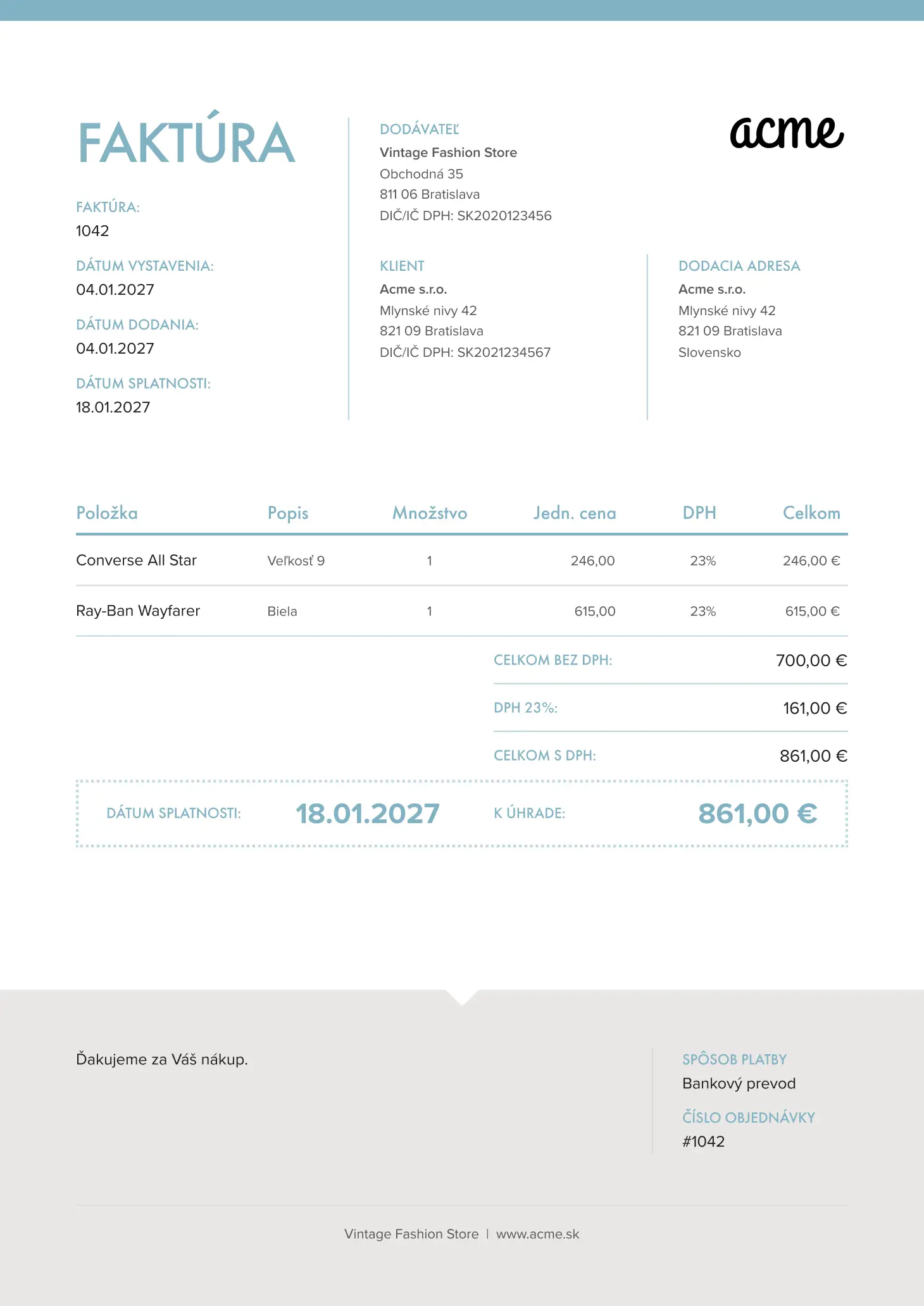
Sufio automatically creates an invoice for every order, compliant with Slovak invoicing requirements.

Structured e-invoices
Sufio creates structured data in the Peppol format required by Slovak law.

Compliant credit notes
Automatically submit correct credit notes for refunds, returns, and edited orders, all linked to the original invoice.

B2B customer details
Display IČO, DIČ, and IČ DPH numbers, payment terms, PO numbers, and other essential company details on invoices.

Certified provider
Sufio sends all documents through a certified digital postman to the Peppol network.

Accurate tax rates
Sufio ensures that the correct tax rates are assigned to shipping costs, restocking fees, and refund amounts.
Built for Shopify B2B
Sufio automatically creates invoices with wholesale pricing and all essential B2B customer details as required by law.
- Company names and legal entity details
- IČO, DIČ, and IČ DPH numbers
- Purchase order (PO) references
- Payment terms and due dates
- Credit notes linked to original invoices
- Sequential invoice numbering
Read our Slovak e-invoicing guide
Our detailed guide covers how electronic invoicing works in Slovakia and how Sufio creates and sends compliant e-invoices to Slovak business customers.
Orders can change. Your invoices should not.
Once an e-invoice is sent, it can no longer be changed.
Sufio automatically creates additional invoices and credit notes for every return, refund, and edited order in Shopify, as legally required.
Order printers update the same invoice.
Against the lawSufio creates separate documents.
Legally correctTake control of your invoice templates
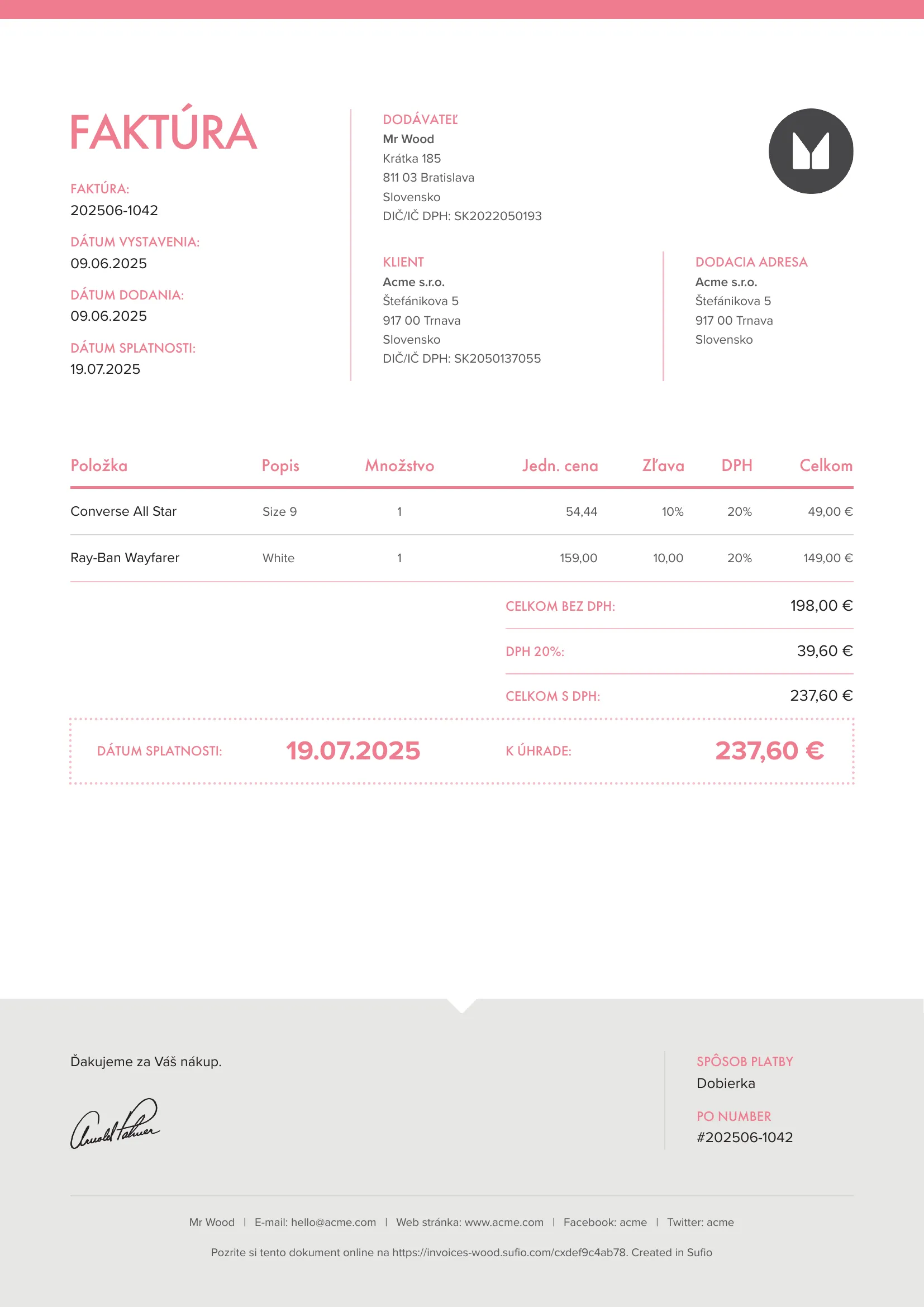
Rename labels and rearrange elements in the visual editor, or edit the template code to display any order, customer, or product property.
Our support team can also make custom changes for you.
Expert setup service tailored to your needs
Our experienced Support Team provides a personalized setup service, ensuring your invoices and taxes are configured correctly.
Get in touch, and we’ll work with you to align your invoices and other documents with your unique business needs, helping you charge the correct taxes and maximize the benefits of Sufio.


Frequently asked questions
It applies to most domestic sales to other businesses and the public sector (B2B and B2G) by VAT-registered businesses based in Slovakia. Slovakia is introducing e-invoicing in phases:
- January 1, 2026: voluntary phase, businesses can already send e-invoices
- January 1, 2027: e-invoicing becomes mandatory for domestic B2B and B2G sales
- July 1, 2030: the rules extend to sales within the EU and to businesses that are VAT registered in Slovakia but not based there
eFaktúra is the local name for Slovakia's e-invoicing system, managed by the Financial Administration of the Slovak Republic (Finančná správa).
Invoices are sent as structured e-invoices through the Peppol network, and their data is reported to the Financial Administration at the same time.
No. Sales to consumers (B2C) are currently outside the scope of eFaktúra. You can keep sending B2C invoices as usual, including as PDFs.
Slovak e-invoices use Peppol BIS Billing 3.0, an XML format based on UBL 2.1 that follows the European standard EN 16931.
It stores all invoice data in a structured form that machines can read. Other countries, such as Belgium, also use Peppol for mandatory B2B e-invoicing.
A digital postman (digitálny poštár) is a certified provider that sends and receives e-invoices for you through the Peppol network. You can choose one from the Financial Administration's official register.
Your digital postman checks each e-invoice and sends it to your customer's digital postman, which passes it on to them. At the same time, the invoice data is reported to the Financial Administration.
Yes. From January 1, 2027, all businesses and other legal entities in Slovakia must be able to receive e-invoices, even if they're not VAT registered.
To receive them, you'll need a certified digital postman, either directly or through accounting or invoicing software that works with one.
Yes. Sufio keeps creating professional PDF invoices that you can email to your customers or let them download from their accounts in your store.
For B2B sales in Slovakia, though, the PDF is only a visual copy. Legally, only the e-invoice counts.
Sufio automatically creates Peppol e-invoices for your Slovak business customers (B2B) and sends them through a certified digital postman.
Prepare your Shopify store for
e-invoicing in Slovakia
Install Sufio today and make sure your store is ready for e-invoicing in Slovakia.