Support of Peppol e-invoicing for Belgian Shopify stores
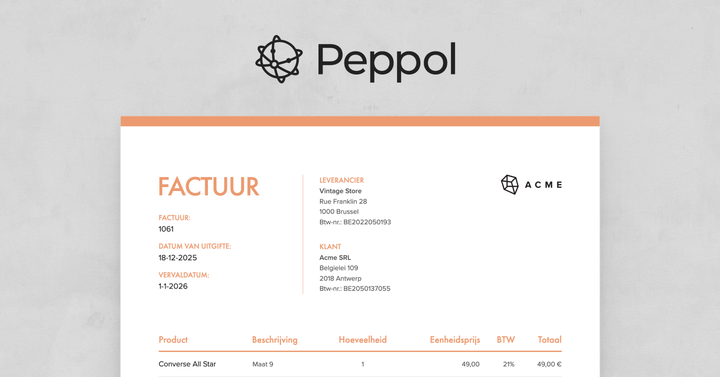
2026 marks a significant change for e-invoicing in Belgium, with new regulations coming into effect that make structured electronic invoicing the default method for most domestic B2B sales.
For sales to VAT-registered Belgian businesses, both invoices and credit notes are expected to be submitted via the Peppol network instead of sending traditional paper or PDF documents.
Sufio is launching support for Peppol e-invoicing to ensure that Shopify stores in Belgium can seamlessly comply with these new requirements.
New e-invoicing regulations in Belgium
Starting January 1, 2026, companies established in Belgium will be required to issue structured e-invoices for most domestic B2B sales to other Belgian VAT-registered businesses.
While suppliers may still provide PDF or paper copies for convenience, these will only serve as a visual representation of the electronic invoice.
The legally valid document will be the structured e-invoice that complies with the European standard EN 16931 and is typically transmitted via the Peppol network.
Certain sales fall outside the scope of this obligation, such as B2C sales to consumers and some VAT-exempt businesses, but for the majority of domestic B2B sales, structured e-invoicing will become the norm.
Belgian lawmakers have defined these rules to modernize invoicing, improve data quality, and create the foundation for further digitalization in areas such as e-reporting.
Support for e-invoices in Sufio
Beginning December 18, 2025, Sufio supports Peppol e-invoicing for Shopify merchants based in Belgium by generating e-invoices for invoices and credit notes and submitting them via the Peppol network to their business (B2B) customers.
This update enables Belgian Shopify stores to comply with the new Belgian e-invoicing regulations without changing how they work with orders and documents in their day-to-day operations.
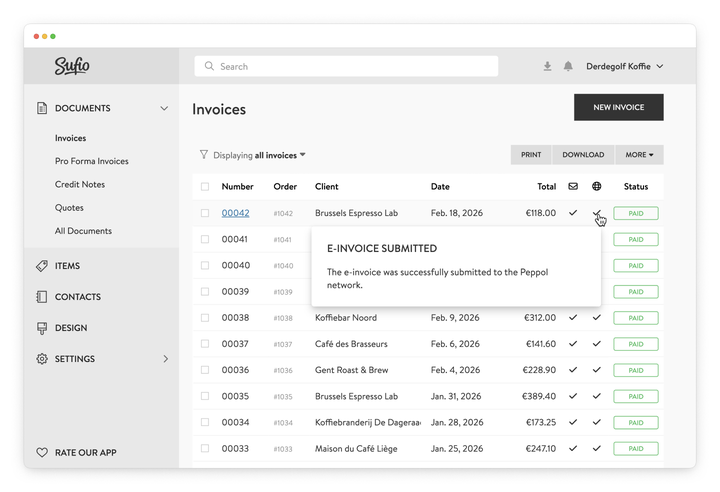
E-invoices are generated and submitted for both invoices automatically created from Shopify orders and those created manually in the Sufio app.
The same approach applies to credit notes, which are supported regardless of whether they are generated automatically from refunds and returns in the online store or are created manually in Sufio.
How do we handle Peppol e-invoicing in Belgium?
For Belgian Shopify stores, Sufio generates e-invoice data in the Peppol BIS Billing 3.0 format, as required for Belgian B2B e-invoicing. This is the standard format used on the Peppol network.
In practice, this means that every qualifying Belgian B2B invoice and credit note has a structured Peppol e-invoice generated behind the scenes.
Sufio then uses a certified Peppol Access Point to submit this e-invoice to the customer’s Peppol endpoint, ensuring that the document can be processed automatically in the customer’s accounting or ERP system.
Sufio continues to provide human-readable PDF documents so merchants and their customers can still view and share invoices in the way they are used to. The only difference is that a structured Peppol e-invoice now handles the compliance and automation layer required by regulation.
Does submitting e-invoices incur any additional fees?
Due to the additional costs associated with using a certified Peppol Access Point to submit your e-invoices to the Peppol network, Sufio charges an extra fee for every e-invoice we successfully send.
This fee is $0.05 USD per e-invoice, up to a maximum amount based on your plan.
It's important to know that we only charge this fee for e-invoices that are successfully sent via the Peppol network.
Please note that Sufio will not charge any fees for sent e-invoices until the end of February 2026, allowing you to try our e-invoicing solution for free.
How do I enable e-invoicing in my Sufio account?
To start using e-invoicing in Sufio, you first need to register your company for e-invoicing in your Sufio account. This requires providing your company details and approving usage charges for successfully sent e-invoices.
Once your company is registered, you can choose how e-invoices should be submitted to the Peppol network.
You can either enable the automatic submitting of e-invoices for all qualifying invoices and credit notes as soon as they are created, or you can keep full control and submit e-invoices manually for each document.
Note
Support for Peppol e-invoices in Sufio is initially available as a public beta for Belgian merchants. We value your feedback—please contact our support team with any questions or suggestions as you start using Peppol e-invoicing in your store.
Further e-invoicing support
With the introduction of Belgian Peppol e-invoicing for Shopify, Sufio continues its mission to help Shopify merchants adapt to new e-invoicing standards worldwide.
Together with support for e-invoicing formats like ZUGFeRD in Germany and Factur-X in France, our goal is to ensure that our invoicing solution for Shopify stores always remains compliant, automated, and reliable.
We’ll keep expanding our e-invoicing capabilities in line with national roadmaps and regulatory changes. Stay tuned for more updates as we enhance Sufio’s e-invoicing features so you can rely on Sufio for compliant invoicing in Belgium and beyond.
Professional invoices for Shopify stores
Let Sufio automatically create and send beautiful invoices for every order in your store.
Install Sufio - Automatic Invoices from the Shopify App Store